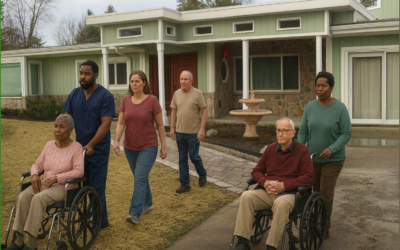
For AFC providers, steady referrals from Community Mental Health Agencies (CMHAs) aren't just good for census — they're a sign that a program has earned real trust in the local system of care. That trust doesn't happen by accident. CMHAs place clients with providers...

Blog
Running a Group Home Is Mission-Driven, But It Still Has to Make Financial Sense.
Administrators and owners who run the financial side of a group home know the tension well: the mission is caring for residents, but the doors only stay open if the numbers work. Rising costs, tight Medicaid reimbursement rates, and unpredictable census can squeeze...
Food Safety Isn’t Theoretical Right Now — It’s the Headlines
This summer, Michigan has reported thousands of cyclosporiasis cases tied to a multistate outbreak traced back to contaminated iceberg lettuce, with hospitalizations reported across the state and beyond. It's a stark reminder that foodborne illness isn't a rare or...
Food Safety Is Not Theoretical: Why AFC Homes Must Treat Every Meal as Resident Protection
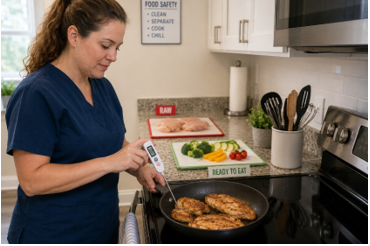
In Summer 2026, foodborne illness continues to dominate public-health headlines, reminding Michigan Adult Foster Care providers that kitchen safety is not an abstract compliance topic. A contaminated ingredient, an improperly cooled meal, or a missed recall can...
Is Your Staff Ready for the Unexpected?
A power outage during a heatwave. A gas leak at 2 a.m. A tornado warning with residents to move safely and quickly. Emergencies in community-based care settings don't wait for a convenient time, and staff who freeze or improvise in the moment put residents at real...
Turn Your Best Caregivers Into Your Best Trainers
Every strong direct care team has someone who naturally teaches others the ropes — but knowing the work and knowing how to train adults to do the work are two very different skill sets. DCTRC's Train-the-Trainer for Instructor Development course closes that gap,...
Protecting Staff from Bloodborne Pathogen Exposure in Group Homes
Direct care staff face bloodborne pathogen exposure risks every day — from assisting with a fall, changing a bandage, or cleaning up after an accident. A single unprotected exposure to Hepatitis B, Hepatitis C, or HIV can have lasting consequences, which is why proper...
Don’t Let Your (MDS) Minimum Data Be The Management Tool You Underuse
In most nursing homes and Adult Foster Care settings, the Minimum Data Set (MDS) is treated as a compliance deadline — a form to complete, submit, and file away. But the MDS is also one of the richest sources of operational data a facility generates, quietly connected...
Beyond Basic Care: Why Group Homes Need Specialized Training for the Medically Fragile
As Michigan's Adult Foster Care (AFC) system continues to serve residents with increasingly complex medical needs, the line between “residential care” and “clinical care” has grown thinner every year. Group homes that once housed residents with primarily behavioral or...
Closing the Gaps: Why Michigan Group Homes Need Trained Internal Care Coordinators
In a Michigan group home, medical coordination happens constantly — an appointment gets scheduled, a prescription changes, a resident's condition shifts, and a caregiver on the next shift needs to know. When that flow of information breaks down, so does continuity of...
Serving the Medically Fragile: A New CEU Standard for Michigan Group Homes
Michigan's Adult Foster Care (AFC) providers are being asked to do more than ever for residents with complex medical needs. Recognizing that gap, Direct Care Training & Resource Center, Inc. (DCTRC) developed Course 1143: How to Develop and Manage Group Living...
Can You Care for Someone You Can’t Communicate With? LEP Training for Direct Care Professionals
In long-term care, a language barrier is never a minor issue. When a resident has Limited English Proficiency (LEP), your ability to protect safety, preserve dignity, and document care accurately is immediately put to the test. For direct care professionals, this is a...
Nutrition Is a Care Standard — Is Your AFC Team Trained to Meet It?
What residents eat, how meals are planned, and whether special diets are followed correctly are not afterthoughts in Michigan Adult Foster Care — they are compliance expectations with direct implications for resident health, licensing standing, and quality of life....
Food Safety Is a Resident Rights Issue — Are Your AFC Staff Trained?
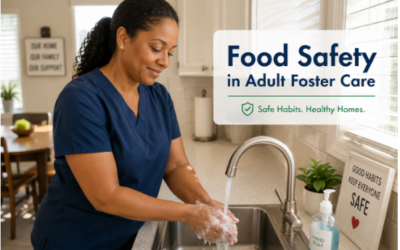
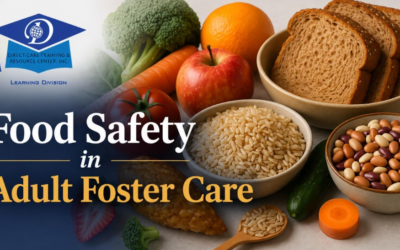
In Michigan Adult Foster Care, food safety is not optional — it is a compliance requirement, a resident dignity issue, and a direct care competency that the Michigan Strategic Training Workgroup (STWG) expects every provider to address. Food Safety in Specialized AFC...
Why Every AFC Staff Member Needs This Course: Introduction to Human Services and Meeting Special Needs
Working in Michigan Adult Foster Care means showing up every day for some of the most vulnerable people in our communities — individuals with intellectual disabilities, mental illness, autism, TBI, and complex behavioral needs. That work demands more than good...
R 400.620 Special license.
Dear Virtual Learning Users: This learning update is intended to advise Adult Foster Care (AFC) providers of a new addition to the Administrator Competency Class, Section 3-K, which addresses the issuance of temporary Michigan AFC licenses. This section clarifies the...
Live, Skill‑Focused CPR, First Aid & Bloodborne Pathogen Training Strengthens Workplace Safety
At Direct Care Training & Resource Center, Inc., we know that real confidence in an emergency comes from hands‑on practice—not from watching a video or clicking through an online module. That’s why we conduct live, in-person, skill‑focused CPR and First Aid...